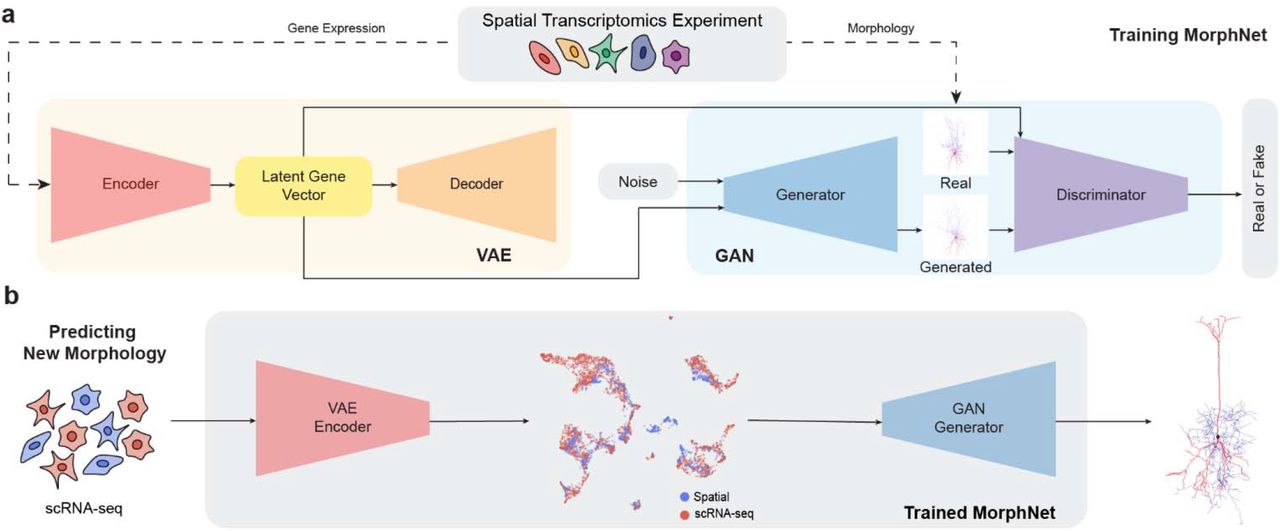
Single-cell RNA sequencing can measure gene expression across large numbers of cells, but collecting detailed morphology from the same cells is much harder. MorphNet asks whether paired datasets can teach a model the relationship between these two views of a cell, then use that relationship to predict morphology for cells that have only gene-expression measurements.
I developed MorphNet during my Ph.D. at the University of Michigan. The 2022 preprint with Joshua Welch introduced the 2D approach for generating nuclear and whole-cell morphology. My 2024 dissertation extended the project to generating complete 3D neuron morphologies.
Learning a distribution of morphologies
Gene expression constrains a cell’s morphology, but it does not uniquely determine it. MorphNet therefore learns a distribution of possible morphologies conditioned on a gene-expression profile rather than predicting a single fixed answer.
The 2D model combines two generative components. A variational autoencoder (VAE) maps high-dimensional gene-expression measurements into a lower-dimensional latent representation. A conditional StyleGAN2 model receives that representation along with noise and generates a morphological image. Training the VAE and GAN separately made the pipeline more stable, while adaptive discriminator augmentation made it possible to train with roughly one thousand paired images instead of the much larger datasets normally used for GANs.
Once trained on paired spatial-transcriptomics or Patch-seq data, MorphNet can encode cells from a single-cell RNA-seq dataset into the same latent space and generate possible morphologies for them.
From 2D images to 3D neurons
The original preprint evaluated nuclear images and whole-cell neuron morphologies. It reported that MorphNet could produce realistic samples, generalize to gene-expression profiles from brain regions not used for training, and interpolate through latent space in ways that corresponded to changes in morphology.
The 3D extension in my dissertation changed the output representation from an image to a complete neuron reconstruction in SWC format. It used an adapted Diffusion Transformer architecture to generate branching axonal and dendritic structures and evaluated the generated neurons using standard morphometric and geometric measurements. The dissertation also explored using the model to complete partial neuron reconstructions.
Current scope
MorphNet depends on paired molecular and morphological measurements for training. Prediction quality therefore depends on both the quantity of paired data and how well a new dataset overlaps with the training distribution. Its outputs are possible morphologies consistent with gene expression, not a claim that a transcriptome uniquely specifies a cell’s shape. The 3D work is described in the dissertation and is separate from the evaluations in the 2022 preprint.