After my Swish and SwiGLU adventure, I wanted to do another set of chronological reading, this time on normalization techniques. Much like the activation functions, these are very commonplace in deep learning architecture, but beyond BatchNorm I hadn’t sat down to read these as a group to parse out the use cases and the limitations that subsequent techniques answer.
Organizing them chronologically:
- BatchNorm (March 2015)
- LayerNorm (July 2016)
- InstanceNorm (November 2017)
- GroupNorm (June 2018)
- RMSNorm (October 2019)
And an additional paper I want to read:
Yesterday I read the BatchNorm, LayerNorm, and GroupNorm paper (and somewhat skimmed over RMSNorm). I actually read InstanceNorm paper quite carefully many years ago because it was quite relevant to the GAN-related work I was doing at that time. Some notes I took yesterday:
- BatchNorm significantly sped up the convergence of models by addressing Internal Covariate Shift. In the paper, the authors also showed BatchNorm allowed training with sigmoid activation functions in Inception-like network, if I remember correctly. I thought that was pretty cool.
- BatchNorm introduces two parameters to learn (scale and shift) per feature.
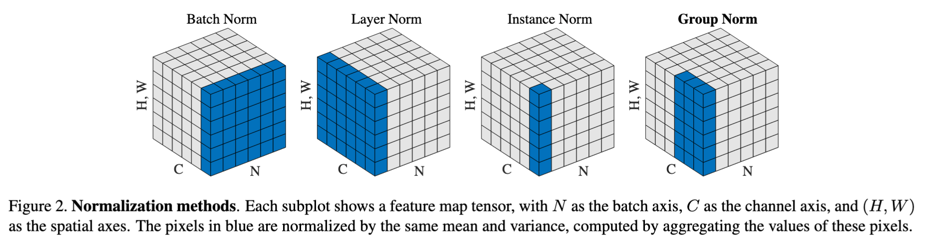
- LayerNorm does something similar but averages across features instead of batch, making it batch size-independent. This was addressing the limitation of BN in settings such as RNN and online learning.
- GroupNorm addresses the limitation of BatchNorm when the batch size is small (i.e. memory constrained problems). This can happen during large image segmentation or video processing, where high-res images limit the batch size one can process.
- GroupNorm is also a generalization of Layer and Instance Norm, depending on the Group $G$. Best explained by their figure below.
More to come about InstanceNorm and RMSNorm.